
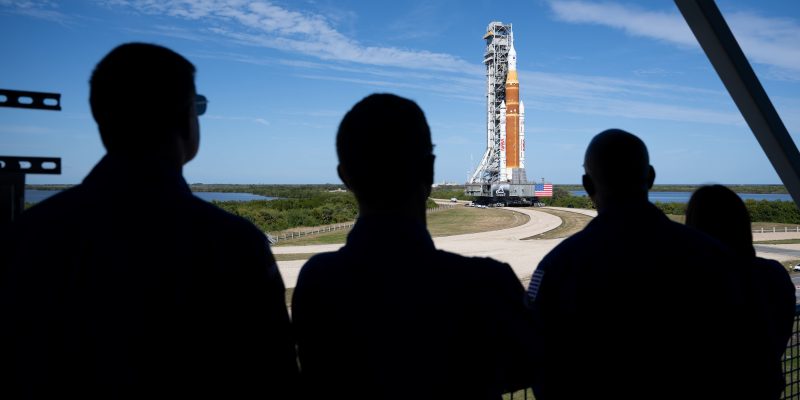
Artemis II, the first spaceflight to the moon in over 50 years, is set to launch no earlier than February 6th. It will mark the first crewed mission to the moon since Apollo 17 in December 1972.
The spacecraft will launch from the Kennedy Space Center in Cape Canaveral, Florida, having arrived at its destination on January 18th. The mission itself is planned to take place over 10 days, with the crew travelling 685,000 miles from Earth.
A simulated launch could happen within a matter of days, testing the 700,000 gallons of propellants that will be loaded into the spacecraft.
Whilst it is not scheduled to land on the moon, it is a crucial test for gaining knowledge for future missions to the surface of the moon, as well as the potential for sending humans to Mars.
Excitement is building for the flight in Bournemouth with the Wessex Astronomical Society eagerly anticipating Artemis II’s launch.
Kate Earl, a member of the Wimborne-based society, shared her enthusiasm.
“I’ll certainly be talking about the latest news as far as that’s concerned. I know certainly all the astronomers will be interested because some of them obviously remember the Apollo mission. For people like me, it is amazing that people are now going out of low Earth orbit and around the moon.”
However, compared to the influence of Apollo 17’s mission, Earl believes that the upcoming launch is unmatched.
“In terms of the impact that it would have had 50 years ago, I don’t think you can compare it. I think the only thing that would maybe compare with that is if they land on the moon. Even though people have landed on the moon before, fifty years is a long time. There’s lots of people who weren’t around to see that with the amazing technology that’s available today.
“It’s important that we keep exploring. Humans are curious by nature and you can’t take that out of us. We’re always going to be moving forward, so going back to the moon with our current technologies is seeing the difference and seeing how we can make them work. This is a big step to getting people and the technologies prepared for longer missions into space and potentially Mars. The moon is a great starting point as we have experience of having gone there before, but there’s been things that have improved significantly.”
Part of Earl’s role within the Wessex Astronomical Society involves holding sessions at schools within the local area. She visited Bournemouth School recently, hoping to stir the students’ anticipation of the mission. However, there are challenges in engaging the modern youth.
“When you’ve grown up knowing that people went on the moon, until you’ve really researched it and how amazing it was and what a feat it was and how difficult it was, you can’t really appreciate it. In modern society today, all of that is out there. I’m certainly trying to encourage poeple and children to watch it.
“I think this mission will certainly inspire some young people in the schools that I go to. We do a lot of outreach and we try and get the children excited, but we’ve been to the moon already. Why are we going back? So that’s what you’ve got to instil in them a sense of awe and wonder, but it’s more difficult now.”
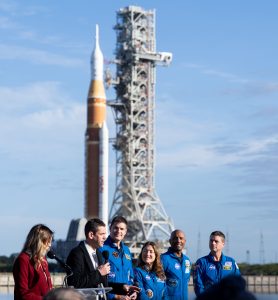
The crew will consist of three NASA astronauts: Reid Wiseman, Victor Glover and Christina Koch. Jeremy Hansen will also join them fromthe Canadian Space Agency.
Preparations are steadily underway within NASA, as the crew entered quarantine last Friday for their health stabilisation programme in Houston. They will fly to Florida six days before the launch.
Christina Koch’s involvement on the mission is significant as she will become the first woman to travel beyond low Earth Orbit. She previously broke the record for the longest-ever single spaceflight by a woman in 2020, spending 328 days on the International Space Station.
For female astronomers like Earl, the gravity of Koch’s place on Artemis II cannot be understated.
“What’s important is that everybody, male, female, or however you represent, sees everybody else, male and females, but also ethnic minorities and different cultures and religions, just all doing everything. I think it’s really great that there are representations of as many different people as possible. Certainly, for countries where it’s a lot harder for women to get roles and get into science, it’s absolutely amazing for them.”
For those interested in following the build-up to the launch, NASA have uploaded a YouTube livestream of the launch pad where you can view the spacecraft.
 Emergency services respond to serious crash in Christchurch