
“If normal rhythm is not restored it will result in death.” Kevin Podger’s HEMS report
Kevin Podger is a retired Royal Navy Engineer Officer in excellent shape for a man of 70 years old. On October 17 2025, he cycled 12 miles to a National Coastwatch Institution outpost to enquire about becoming a volunteer. He then cycled the 12 miles back towards his home in the sailing town of Lymington, Hampshire. Not far from home, he crested the steep hill of the High Street and the dual unknowns of an early Covid-19 infection and a narrowed artery caused him to have a massive cardiac arrest and collapse on the street.
Kevin’s life was saved by a trio of well-trained first aiders who happened to be nearby, Andres – a personal trainer and ex-lifeguard who immediately began performing CPR, Kenna – who came running from the local Boots and called 999, she recognised it as a Cardiac Arrest and was able to convey this to Emergency Services, this made Kevin’s case a priority and alerted Fire Service Co-Responder John to head over from just 500m away.
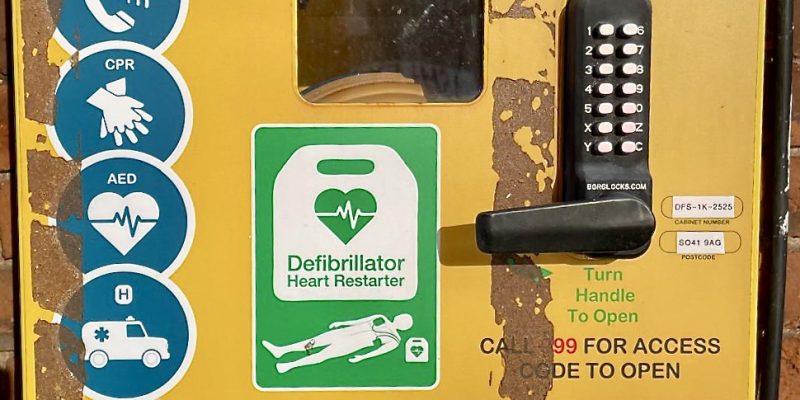
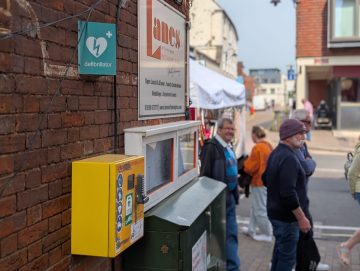
While Andres was administering CPR and John was on his way from the station, Kenna was still on the call with the Emergency Services trying to get access to the nearest Automatic External Defibrillator (AED) less than 50 metres away, Emergency Services were giving a code, but the lock box stayed shut. Nobody was able to gain access that day.
Andres, Kenna and John all kept Kevin alive long enough for a Helicopter Emergency Medical Service (HEMS) team to land nearby and escort Kevin to the hospital.
Life Saving Devices.
Statistics published by the British Heart Foundation (BHF) state that for a person who has an Out of Hospital Cardiac Arrest (OHCA) the chances of surviving are only around 7-9% without any kind of medical intervention. When a defibrillator is used that number skyrockets to between 50-70-%.
For every minute a defibrillator is not used the chance of survival drops by around 9%. Some estimates for survival rates when a defibrillator is used in the first minute are put as high as 90%.
Accessibility Issues
AEDs are located across the country, yet many are in a state of disrepair, unregistered with emergency services, unmaintained with dead batteries and seized up lock boxes, or simply too far away to save a life. Residents of more deprived areas will find themselves with all these issues plus the fact they will be even further away than in affluent areas.
What makes the system problematic is that there is no national oversight or regulation of these devices. AEDs are bought and operated under a “Guardianship” program. Community centres, pubs, shops, village halls and even private residences can choose to purchase them to benefit and keep safe the community around them, but once they’re installed, they need regular maintenance. Even if the defibrillator remains unused the pads (or electrodes) need replacing every 18-24 months as the adhesive gel that attaches to skin can dry out. The batteries need replacing every 2-4 years as they will slowly drain over time. Once an AED has been used once both parts need replacing before it can be used again.
Falling by the wayside.
Herein lies the problem, after installation any number of things might happen. For example, a pub might install an AED to serve their community, but (especially given the state of the pub industry now) the pub might close or change hands, or the landlord may simply put the maintenance to the back of their mind while they go about their daily business. Same goes for a high street shop (The AED inaccessible to Kevin’s rescuers was installed by a branch of New Look that had long since closed), once management or ownership of a premises has changed hands a few times who knows what information is ultimately passed down, like a deadly game of Chinese whispers.
The Circuit.
The BHF and Resuscitation Council UK provide an excellent service known as The Circuit, where guardians can register their AEDs, making their whereabouts and access codes known to Emergency Services. You can find your nearest accessible AED here: https://www.defibfinder.uk/
Around 13% of registered AEDs are marked as “out-of-service” at any given time on The Circuit, but separate field studies commissioned by Resuscitation UK found the figure to be closer to 20%. The same report also found around 29% were in restricted-access areas such as inside schools, offices, and private residences such as apartment buildings, severely limiting the number of AEDs available to the person on the street. There is no way to know how many unregistered, locked defibrillators are out there.
Minutes Matter.
Stephen Metcalfe is a former conservative MP for South Basildon and East Thurrock, he proposed a “10 Minute Rule” private members bill, which would require AEDs to be installed in all new property developments consisting of 10 or more units. The idea was proposed to him by a constituent first responder who explained part of the constituency is effectively cut off due to the access roads regularly being blocked by two level crossings. Paramedics would race to the area only to be blocked and forced to wait for the trains to pass, making CPR, defibrillators, and Co-responders critical to the survival of the residents.
This conversation led Stephen, who served on the House of Commons Science, Innovation and Technology Committee, to research and propose a bill which would begin to increase the numbers of properly maintained AEDs across the country. The bill proposed that property developers would be responsible, and liable for, the maintenance and upkeep of the new AEDs, which Stephen claims was well received by the developers he spoke to.
“It’s no good just putting the thing in place. It’s got to be maintained, otherwise it’s just a nice yellow box on the side somewhere.” Stephen Metcalfe
Universal Approval.
It was one of those rare policies that seemed to go down well with everybody involved, developer maintenance could have solved at least some of the oversight issue. Another key aspect Stephen stressed was that the more affluent an area was, the more likely there would be a quickly accessible AED. Because of the guardianship/volunteer nature of the system, its much less likely a more deprived area would have enough defibrillators to serve the community.
In 2024 Stephen lost his seat to James McMurdock, who was standing for Reform UK at the time but has since had to become an independent following multiple reports of shady practices prior to running as a candidate.
Unfortunately, this meant the 10 Minute Bill has fallen to the wayside. This low public cost, high impact, potentially lifesaving policy is no longer currently on the table. Stephen hopes it might still be taken up, saying “it could be slipped in as an amendment or an addition to a larger piece of legislation.”
The Illusion of Safety.
Freya Shaw is a journalist working for The Economist, The Observer and BBC’s The Naked Week. She spent several months investigating local council managed AEDs. Freedom of Information (FOI) requests were sent to every borough, county, district and city council in England, Scotland, and Wales. Many of them were unaware of how frequently their AEDs should be checked and maintained, she also found many were locked inside closed buildings, thereby only available at certain times of the day.
“In the end, they could be harming more people by being reliant on a defibrillator that doesn’t work.” Freya Shaw
Freya found that many charities and community groups had installed defibrillators following a local tragedy, a family or community member may have passed, and it is then decided that an AED should be placed in an accessible local area. The responsibility of maintaining the AED then stays with that charitable group, but over 5, 10, 15 years the maintenance can understandably fall to the back of a collective mind. Freya’s work has encouraged many councils to check their publicly owned defibrillators, one even told her that the AED inside their own office had expired pads and a flat battery.
“Local charities are carrying the burden after suffering themselves.” Freya Shaw
Consensus.
Everybody spoken to for this article shared multiple aligning opinions. Local groups, businesses and councils are taking a responsible, practical, and potentially lifesaving choice by installing these devices. It’s the lack of oversight that causes the problem. They also each independently mentioned fire extinguishers, fire blankets and smoke alarms. These items are privately purchased, but mandatory in most buildings and legislated under the Fire Safety Act 2022 and the Building Safety Act 2022. Stephen and Kevin also noted that some new AEDs are being installed without any kind of lock or code, as this is an access barrier in an emergency situation, and where unlocked boxes do exist there seems to be minimal records of vandalism.
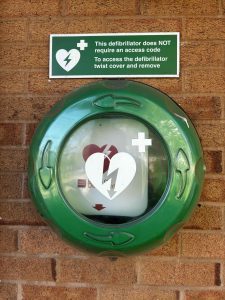
“Defibrillators should be like fire extinguishers — immediately available when you need them.” Kevin Podger
Kevin has now been cleared by his Cardiac Consultant to participate in all the cycling and sailing he wishes, he teaches keelboat sailing for a local school and is now beginning his training as a National Coastwatch Institution Watchkeeper. He continues to advocate for better access to AEDs with the British Heart Foundation.
Resuscitation Council UK and The British Heart Foundation were contacted for this article but did not respond.
 Poole Town meets local community